Sunday 21st February was a very interesting day for me- I got to visit Denis Island for the first time! I did not know what to expect as I’ve read so much the island and liking it instantaneously, without really knowing it! As the plane hovered over the island, I sat in awe as I stared down at the crystal clear waters and the array of greens, clearly visible from high above. The first sight of the island surely impressed me. Once the plane landed, I was met by a number of the island staff, from both the hotel and the estate; at that point in time, I knew that there will be lots to do and learn around the island! I was then introduced to Mr. Camille Hoareau who was going to show me around the island to provide me with a good insight of the ‘real thing’ in situ.
After the plane left, it was back to usual business for everyone. I was driven to the staff canteen to enjoy a nice Sunday lunch before checking out my accommodation and doing the island tour. Seeing the mix of staff of the island was interesting- my presence arose some curiosity but before lunch was over, I have talked to several staff and got their perspectives of the island and its biodiversity. My first impression of the island was one of absolute awe; peaceful surrounding with various bird species flying around, perfect sunny weather giving a nice aura to the grass, while the waves slowly splash on the beautiful sandy beaches. With these characters showing off to me, I knew then and there that the island has a lot to offer and its biodiversity is simply amazing, hence worth preserving!
The tour of the island was done in a golf car with Mr. Hoareau as the driver and my camera in focus, to try and capture the best shots as we drove along and stopped at the various sites of interests. Some of the most fascinating things I saw was a Seychelles warbler and a Seychelles magpie robin (Copsychus sechellarum) (photo in side bar) coming quite close to the golf car, following Mr.Hoareau’s call. Driving past and through the woodland forest, I saw the feeding stations of the SMR empty, even if food had just been placed. However, not one of the birds was in sight. The native woodland forest is evergreen and rich of life (picture in side bar); constant bird calls resonating from its every corner are simply amazing. Moving on, I got the chance to see the ongoing rehabilitation area, where young coconut seedlings are pulled out- the shoots are mashed up to provide fodder for the livestock on the estate. Papaya grows in great abundance all around the island and it is amazing to see the size of the fruits on those thin trees. Even if they are found within the woodland boundary and other prime land, the fruits are also used as food source for humans and the livestock. Nothing is wasted really- accumulated seaweeds during the monsoons are placed in a big stack to allow rinsing when it rain and decomposition into more ‘friendly’ materials to be used as compost on the vegetable garden.
Other problematic invasive species are removed from the forest in order to allow young native seedlings to proliferate. This activity is laborious but it is worth mentioning that the estate staff with the help of the management staff is determined to keep it going- well done guys! Lots of effort and investment are being put in the restoration and maintenance of near-natural habitats. This is an ongoing and never-ending venture which must be applauded and further encouraged, to allow continuity and eventually engage other islands to follow suit.
Sometimes we don’t really understand how Nature works! Driving along the coastline, I noticed that there are serious erosion issues, leading to loss of beach materials and vegetation, including beautiful but enormous casuarina trees- a real shame!! There are plans to mitigate some of the vegetation loss and beach erosion, once the ICZM project, funded by the ReCoMaP kick-start. It will not be the answer to this problem, but it will provide a certain degree of coastline protection in the long run. New and large beaches have been formed and large amounts of materials have been transported all along the coastline. This in turn leads to ‘suffocation’ and displacement of coastal vegetation as the plants are fully exposed to other natural elements and the open sea. Large trees such as casuarina that have been resident on the coast are now disappearing at very fast rate, thus raising alarm on the urgency for mitigative measures to be put in place.
Driving past, I noticed a very distinct spot at Bel Etoile beach where the coastal features have molded the reef flat into wonderful architecture; the sight was indeed mesmerizing. This site was very popular for wedding ceremonies but with time, the system has disintegrated with prolong wave erosive actions. Such loss really prompts the urgent need to act now, so as to, if possible, lessen such impact on other coastal features.
As the sun went down, I stood in total amazement as myriads of birds came to settle on their favorite branches and trees for the night. I made a new friend, a fairy tern which was curious to observe what I was doing with the camera. I tried to take its photo but it was too busy playing and in the end, I chose to admire them all! Once darkness settled in, I made my way to settle for the night.
The next morning, I decided to have an early morning walk with my camera with the idea of capturing some other good shots. Everywhere was quiet and there was not much action; I diverted to the kitchen for breakfast as it was uneventful. I encountered a brown noddy chick taking its time to get around. It was friendly as it proudly stood to pose for me (photo on side bar) and I was happy to get my first photo for the day. As the sun rose higher up, it started to get very hot and wandering around the island for photos mid-morning was becoming quite a task. By then it was also time to get my bag ready for my return trip back to Mahé, so I headed back to the house.
It had been a very interesting first trip which have impressed me a lot and giving me the feeling to return as soon as possible. It was amazing to see what lies within the trees and branches of Denis Island and to have a good insight as well as the element of surprise as to what will be waiting for me when I return soon, to get started on the coastal zone project!
Showing posts with label Seychelles magpie robin. Show all posts
Showing posts with label Seychelles magpie robin. Show all posts
Monday, March 15, 2010

Monday, March 23, 2009
SMR News 7: A population status review…
On the 25th of June 2008 20 Magpie robins were flown to Denis on a chartered Twin Otter. 16 of the birds came from Fregate and 4 from the island of Cousin[1]. Translocation is a highly stressful experience for the birds and fatalities are not unexpected. The birds all arrived in apparently good condition however including the four from Cousin, which had experienced a sea crossing from Cousin to Praslin that morning prior to their flight to Denis.
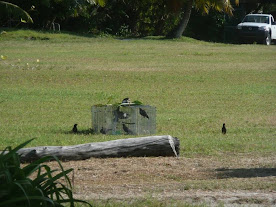
A soft introduction method was utilised with the birds being kept by pairs in aviaries that were positioned in appropriately wooded and tranquil locations around the island. Veterinary expertise was on hand courtesy of the Durrell Wildlife Trust as Jersey Zoo, UK. The birds were released on a staggered schedule 2-3 weeks after arrival. Sadly one bird was lost whilst in captivity, a young female, that succumbed to a lung infection the type of which is linked to lowered immune response due to stress – i.e. most likely a casualty of the introduction process.
The released birds however, settled in very quickly, territories were soon formed and males could be heard singing from strategic vantage points high up in the casuarina trees.
Since their arrival the birds have received individual and dedicated care from Catherina Onezia, the GIF Project Officer. Catherina checks on the condition and activities of the birds and provides each territory with a special supplementary food mix 3 times-a-day.
The first egg was recorded on the 4th August and it hatched the on the 23rd! A fantastic start! Unfortunately the chick was later found dead below its nest possibly the victim of a Mynah bird attack.
By the end of December (i.e. 6 months after introduction) there had been a total of 13 nesting attempts recorded. 9 attempts failed:1 pullus was lost (as mentioned above) 2 nests were destroyed by Mynah birds the others failed at the nest building or egg stage. 4 were successful but two of the fledglings were lost – one due to an apparent abnormality with its legs and the other to unknown causes. So by the end of the year the islands population stood at 21 birds – an overall increase of 1. Compared to some past introductions elsewhere this was a very good beginning as a few birds can be lost in the early stages of an introduction before the population stabilises.
The number of nesting attempts is very encouraging and shows that the birds are in good condition and finding the habitat on the island suitable, but the number of failures in breeding is a cause for concern and certainly we need to investigate ways of improving the success rate. I have covered in detail (in my posts of 17th February and 17th March) the issues we are facing with the Indian Mynahs and how evidence is growing that they may be the main problem.
Catherina eventually had to take the injured chick (from the 17th February post) into fulltime care but the bird prospered there and has subsequently been released as an independent bird – the second chick Catherina has successful raised by hand!
At time of writing the island population now stands at 22 birds, including the loss of an adult to unknown causes, so there has been some additional breeding success this year. Let’s hope that we have turned a corner and that 2009 will be year of steady population growth! Keep checking back for updates…
[1] The SMR introduction was the result of a multi-partner cooperation in a project led by Nature Seychelles, supported by SMART (The Seychelles Magpie Robin Recovery Team – a multi-partner initiative) and in particular Fregate Island Limited.
A soft introduction method was utilised with the birds being kept by pairs in aviaries that were positioned in appropriately wooded and tranquil locations around the island. Veterinary expertise was on hand courtesy of the Durrell Wildlife Trust as Jersey Zoo, UK. The birds were released on a staggered schedule 2-3 weeks after arrival. Sadly one bird was lost whilst in captivity, a young female, that succumbed to a lung infection the type of which is linked to lowered immune response due to stress – i.e. most likely a casualty of the introduction process.
The released birds however, settled in very quickly, territories were soon formed and males could be heard singing from strategic vantage points high up in the casuarina trees.
Since their arrival the birds have received individual and dedicated care from Catherina Onezia, the GIF Project Officer. Catherina checks on the condition and activities of the birds and provides each territory with a special supplementary food mix 3 times-a-day.
The first egg was recorded on the 4th August and it hatched the on the 23rd! A fantastic start! Unfortunately the chick was later found dead below its nest possibly the victim of a Mynah bird attack.
By the end of December (i.e. 6 months after introduction) there had been a total of 13 nesting attempts recorded. 9 attempts failed:1 pullus was lost (as mentioned above) 2 nests were destroyed by Mynah birds the others failed at the nest building or egg stage. 4 were successful but two of the fledglings were lost – one due to an apparent abnormality with its legs and the other to unknown causes. So by the end of the year the islands population stood at 21 birds – an overall increase of 1. Compared to some past introductions elsewhere this was a very good beginning as a few birds can be lost in the early stages of an introduction before the population stabilises.
The number of nesting attempts is very encouraging and shows that the birds are in good condition and finding the habitat on the island suitable, but the number of failures in breeding is a cause for concern and certainly we need to investigate ways of improving the success rate. I have covered in detail (in my posts of 17th February and 17th March) the issues we are facing with the Indian Mynahs and how evidence is growing that they may be the main problem.
Catherina eventually had to take the injured chick (from the 17th February post) into fulltime care but the bird prospered there and has subsequently been released as an independent bird – the second chick Catherina has successful raised by hand!
At time of writing the island population now stands at 22 birds, including the loss of an adult to unknown causes, so there has been some additional breeding success this year. Let’s hope that we have turned a corner and that 2009 will be year of steady population growth! Keep checking back for updates…
[1] The SMR introduction was the result of a multi-partner cooperation in a project led by Nature Seychelles, supported by SMART (The Seychelles Magpie Robin Recovery Team – a multi-partner initiative) and in particular Fregate Island Limited.
Subscribe to:
Posts (Atom)




 Posts
Posts