Sunday 21st February was a very interesting day for me- I got to visit Denis Island for the first time! I did not know what to expect as I’ve read so much the island and liking it instantaneously, without really knowing it! As the plane hovered over the island, I sat in awe as I stared down at the crystal clear waters and the array of greens, clearly visible from high above. The first sight of the island surely impressed me. Once the plane landed, I was met by a number of the island staff, from both the hotel and the estate; at that point in time, I knew that there will be lots to do and learn around the island! I was then introduced to Mr. Camille Hoareau who was going to show me around the island to provide me with a good insight of the ‘real thing’ in situ.
After the plane left, it was back to usual business for everyone. I was driven to the staff canteen to enjoy a nice Sunday lunch before checking out my accommodation and doing the island tour. Seeing the mix of staff of the island was interesting- my presence arose some curiosity but before lunch was over, I have talked to several staff and got their perspectives of the island and its biodiversity. My first impression of the island was one of absolute awe; peaceful surrounding with various bird species flying around, perfect sunny weather giving a nice aura to the grass, while the waves slowly splash on the beautiful sandy beaches. With these characters showing off to me, I knew then and there that the island has a lot to offer and its biodiversity is simply amazing, hence worth preserving!
The tour of the island was done in a golf car with Mr. Hoareau as the driver and my camera in focus, to try and capture the best shots as we drove along and stopped at the various sites of interests. Some of the most fascinating things I saw was a Seychelles warbler and a Seychelles magpie robin (Copsychus sechellarum) (photo in side bar) coming quite close to the golf car, following Mr.Hoareau’s call. Driving past and through the woodland forest, I saw the feeding stations of the SMR empty, even if food had just been placed. However, not one of the birds was in sight. The native woodland forest is evergreen and rich of life (picture in side bar); constant bird calls resonating from its every corner are simply amazing. Moving on, I got the chance to see the ongoing rehabilitation area, where young coconut seedlings are pulled out- the shoots are mashed up to provide fodder for the livestock on the estate. Papaya grows in great abundance all around the island and it is amazing to see the size of the fruits on those thin trees. Even if they are found within the woodland boundary and other prime land, the fruits are also used as food source for humans and the livestock. Nothing is wasted really- accumulated seaweeds during the monsoons are placed in a big stack to allow rinsing when it rain and decomposition into more ‘friendly’ materials to be used as compost on the vegetable garden.
Other problematic invasive species are removed from the forest in order to allow young native seedlings to proliferate. This activity is laborious but it is worth mentioning that the estate staff with the help of the management staff is determined to keep it going- well done guys! Lots of effort and investment are being put in the restoration and maintenance of near-natural habitats. This is an ongoing and never-ending venture which must be applauded and further encouraged, to allow continuity and eventually engage other islands to follow suit.
Sometimes we don’t really understand how Nature works! Driving along the coastline, I noticed that there are serious erosion issues, leading to loss of beach materials and vegetation, including beautiful but enormous casuarina trees- a real shame!! There are plans to mitigate some of the vegetation loss and beach erosion, once the ICZM project, funded by the ReCoMaP kick-start. It will not be the answer to this problem, but it will provide a certain degree of coastline protection in the long run. New and large beaches have been formed and large amounts of materials have been transported all along the coastline. This in turn leads to ‘suffocation’ and displacement of coastal vegetation as the plants are fully exposed to other natural elements and the open sea. Large trees such as casuarina that have been resident on the coast are now disappearing at very fast rate, thus raising alarm on the urgency for mitigative measures to be put in place.
Driving past, I noticed a very distinct spot at Bel Etoile beach where the coastal features have molded the reef flat into wonderful architecture; the sight was indeed mesmerizing. This site was very popular for wedding ceremonies but with time, the system has disintegrated with prolong wave erosive actions. Such loss really prompts the urgent need to act now, so as to, if possible, lessen such impact on other coastal features.
As the sun went down, I stood in total amazement as myriads of birds came to settle on their favorite branches and trees for the night. I made a new friend, a fairy tern which was curious to observe what I was doing with the camera. I tried to take its photo but it was too busy playing and in the end, I chose to admire them all! Once darkness settled in, I made my way to settle for the night.
The next morning, I decided to have an early morning walk with my camera with the idea of capturing some other good shots. Everywhere was quiet and there was not much action; I diverted to the kitchen for breakfast as it was uneventful. I encountered a brown noddy chick taking its time to get around. It was friendly as it proudly stood to pose for me (photo on side bar) and I was happy to get my first photo for the day. As the sun rose higher up, it started to get very hot and wandering around the island for photos mid-morning was becoming quite a task. By then it was also time to get my bag ready for my return trip back to Mahé, so I headed back to the house.
It had been a very interesting first trip which have impressed me a lot and giving me the feeling to return as soon as possible. It was amazing to see what lies within the trees and branches of Denis Island and to have a good insight as well as the element of surprise as to what will be waiting for me when I return soon, to get started on the coastal zone project!
Showing posts with label Invasive alien species. Show all posts
Showing posts with label Invasive alien species. Show all posts
Monday, March 15, 2010

Tuesday, March 17, 2009
The Indian Mynah (Acridotheres tristis) – a growing problem…
In my post of February 17th I recorded that a Magpie robin chick had been attacked in its nest by four Mynah birds working in unison! The male did his best to defend the chick but it was this territory that had lost the female only a day or two before. As such the male was alone and whilst he fought with two birds the other two swooped on the nest to attack the chick! The chick was saved by the intervention of Catherina who fortunately was working in the territory at the time and ultimately she has taken it into her care in order to raise it by hand. This kind of cooperation between the mynahs speaks to their high intelligence. I recall in the mid-nineties seeing four mynahs working together on Cousine island to drive a Fairy tern (Gygis alba) from its egg which they then promptly broke and consumed.
The mynah bird appears to be the main problem that faces the magpie robins on Denis with at least two other nests known to have been destroyed by mynahs and at least one chick fatality that suggested mynah involvement.
The Indian or Common Mynah (Acridotheres tristis) is an introduced or Invasive Alien Species (IAS) to Seychelles. Its native range is central and southern Asia and it is widely distributed throughout the Indian subcontinent. It is believed to have been introduced to Seychelles via Mauritius in the late 18th century either as caged bird or possibly as an early and misguided attempt to control crop pests.
The mynah is a highly intelligent and adaptable bird and exploits all terrestrial habitats in the central archipelago from reef flats exposed at low tide to the highest peaks. Though predominantly a ground feeder, the mynah is able to exploit diverse local and temporary food sources. In Seychelles they have been identified as competitors with (for nest sites and food) and/or predators of (chicks and eggs) threatened endemic land birds such as the magpie-robin, Seychelles white-eye (Zosterops modesta) and Seychelles Scops owl (Otus insularis).
Since its introduction the species has spread progressively throughout the central archipelago. Its date of arrival on Denis is not clear but was sometime in the 20th Century as Fryer did not record the bird on the island in either of his visits (1905, 1908) but Stoddart did record it as present during his visit in 1977. Today at a very rough estimate there are some 300 – 400 mynahs on Denis. They can be best seen in the late afternoon feeding on the runway when as many as 150 birds may be seen at one time spread across the entire length of the strip.
The problem now is how do we go about controlling the mynah population? This is far from easy for various reasons. The mynah population has been controlled in the past on Denis using poison. This was done in 2002 in tandem with the rat eradication project that year. The birds were habituated to being fed in a certain location over a period of several days and then the food source was poisoned. This was very effective but was only possible at that time because the island had no rare native birds. Today particularly with the Magpie robin and Fody (and to a lesser extent the Warbler and Flycatcher) we cannot risk using poison for fear of killing one of these rare birds either by direct or secondary exposure to poison. The other options are trapping or shooting but these too bring difficulties.
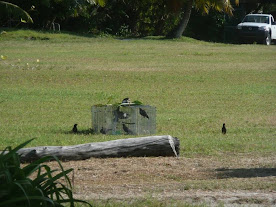
Traps cannot be left unattended as again non-target species may be caught; as such trapping methods used must be i). ones that do not inflict injury or harm in the process of capture, and ii). must be permanently manned such that non-target birds can be promptly released; and again the mynah’s extraordinary intelligence also comes into play. Whilst working on Cousine Island in the 90’s I instituted a bounty system on the island such that staff were paid SR100 for each mynah they caught. SR100 was worth a lot more then than it is today and consequently staff devoted quite a lot of time and effort to the capture of the birds. In particular I recall Mme. Juliana Souffe catching birds using a simple walk-in pull-string trap that she baited with open papaya fruit. She set the trap up across a track from the kitchen where she spent several hours a day and when a bird went in she simply pulled the string and bagged a bird! After initial success however this method ceased to work. The birds worked out the link of the string to the trap – so Juliana changed the string to a transparent nylon fishing line and latterly buried it from the trap under the sand but the birds still worked it out. What was particularly alarming however was that birds did not just learn to avoid the trap and resist the temptation of the mouth-watering fruit inside – an adaption that one could perhaps expect. Rather they worked out that the string and not the trap was the dangerous item… so they would happily enter a trap which had no line attached and feast on the papaya but would not enter a trap which had a line attached…. now that is frighteningly intelligent!!!
Shooting poses other problems. Firstly it can be very difficult to get permission for a firearm, even an air rifle; secondly the mynahs work it out!! On Cousine we got permission for an air rifle in 1995 and initially were able to shoot a few mynahs. Then however after awhile if you walked around with the rifle you never saw a mynah, but when you didn’t have the gun you saw them everywhere! In other words they had associated the gun with the danger rather than just the human! We could of course seek help from the military or a police unit to get a marksman over with a 2.2 rifle but such activity is not compatible with a hotel resort in full operation – so what to do?
We have actually identified a company in Australia that makes a specialised mynah trap which has certain features which are supposed to overcome the wits of these brainy birds. So I have asked the island owners to order a couple so we can try them out. Let’s hope we can get them in the not too distant future and that they may prove effective in gradually getting the mynah population under control!
The mynah bird appears to be the main problem that faces the magpie robins on Denis with at least two other nests known to have been destroyed by mynahs and at least one chick fatality that suggested mynah involvement.
The Indian or Common Mynah (Acridotheres tristis) is an introduced or Invasive Alien Species (IAS) to Seychelles. Its native range is central and southern Asia and it is widely distributed throughout the Indian subcontinent. It is believed to have been introduced to Seychelles via Mauritius in the late 18th century either as caged bird or possibly as an early and misguided attempt to control crop pests.
The mynah is a highly intelligent and adaptable bird and exploits all terrestrial habitats in the central archipelago from reef flats exposed at low tide to the highest peaks. Though predominantly a ground feeder, the mynah is able to exploit diverse local and temporary food sources. In Seychelles they have been identified as competitors with (for nest sites and food) and/or predators of (chicks and eggs) threatened endemic land birds such as the magpie-robin, Seychelles white-eye (Zosterops modesta) and Seychelles Scops owl (Otus insularis).
Since its introduction the species has spread progressively throughout the central archipelago. Its date of arrival on Denis is not clear but was sometime in the 20th Century as Fryer did not record the bird on the island in either of his visits (1905, 1908) but Stoddart did record it as present during his visit in 1977. Today at a very rough estimate there are some 300 – 400 mynahs on Denis. They can be best seen in the late afternoon feeding on the runway when as many as 150 birds may be seen at one time spread across the entire length of the strip.
The problem now is how do we go about controlling the mynah population? This is far from easy for various reasons. The mynah population has been controlled in the past on Denis using poison. This was done in 2002 in tandem with the rat eradication project that year. The birds were habituated to being fed in a certain location over a period of several days and then the food source was poisoned. This was very effective but was only possible at that time because the island had no rare native birds. Today particularly with the Magpie robin and Fody (and to a lesser extent the Warbler and Flycatcher) we cannot risk using poison for fear of killing one of these rare birds either by direct or secondary exposure to poison. The other options are trapping or shooting but these too bring difficulties.
Traps cannot be left unattended as again non-target species may be caught; as such trapping methods used must be i). ones that do not inflict injury or harm in the process of capture, and ii). must be permanently manned such that non-target birds can be promptly released; and again the mynah’s extraordinary intelligence also comes into play. Whilst working on Cousine Island in the 90’s I instituted a bounty system on the island such that staff were paid SR100 for each mynah they caught. SR100 was worth a lot more then than it is today and consequently staff devoted quite a lot of time and effort to the capture of the birds. In particular I recall Mme. Juliana Souffe catching birds using a simple walk-in pull-string trap that she baited with open papaya fruit. She set the trap up across a track from the kitchen where she spent several hours a day and when a bird went in she simply pulled the string and bagged a bird! After initial success however this method ceased to work. The birds worked out the link of the string to the trap – so Juliana changed the string to a transparent nylon fishing line and latterly buried it from the trap under the sand but the birds still worked it out. What was particularly alarming however was that birds did not just learn to avoid the trap and resist the temptation of the mouth-watering fruit inside – an adaption that one could perhaps expect. Rather they worked out that the string and not the trap was the dangerous item… so they would happily enter a trap which had no line attached and feast on the papaya but would not enter a trap which had a line attached…. now that is frighteningly intelligent!!!
Shooting poses other problems. Firstly it can be very difficult to get permission for a firearm, even an air rifle; secondly the mynahs work it out!! On Cousine we got permission for an air rifle in 1995 and initially were able to shoot a few mynahs. Then however after awhile if you walked around with the rifle you never saw a mynah, but when you didn’t have the gun you saw them everywhere! In other words they had associated the gun with the danger rather than just the human! We could of course seek help from the military or a police unit to get a marksman over with a 2.2 rifle but such activity is not compatible with a hotel resort in full operation – so what to do?
We have actually identified a company in Australia that makes a specialised mynah trap which has certain features which are supposed to overcome the wits of these brainy birds. So I have asked the island owners to order a couple so we can try them out. Let’s hope we can get them in the not too distant future and that they may prove effective in gradually getting the mynah population under control!
Subscribe to:
Posts (Atom)




 Posts
Posts