On the 25th of June 2008 20 Magpie robins were flown to Denis on a chartered Twin Otter. 16 of the birds came from Fregate and 4 from the island of Cousin[1]. Translocation is a highly stressful experience for the birds and fatalities are not unexpected. The birds all arrived in apparently good condition however including the four from Cousin, which had experienced a sea crossing from Cousin to Praslin that morning prior to their flight to Denis.
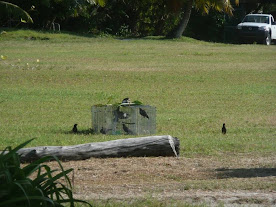
A soft introduction method was utilised with the birds being kept by pairs in aviaries that were positioned in appropriately wooded and tranquil locations around the island. Veterinary expertise was on hand courtesy of the Durrell Wildlife Trust as Jersey Zoo, UK. The birds were released on a staggered schedule 2-3 weeks after arrival. Sadly one bird was lost whilst in captivity, a young female, that succumbed to a lung infection the type of which is linked to lowered immune response due to stress – i.e. most likely a casualty of the introduction process.
The released birds however, settled in very quickly, territories were soon formed and males could be heard singing from strategic vantage points high up in the casuarina trees.
Since their arrival the birds have received individual and dedicated care from Catherina Onezia, the GIF Project Officer. Catherina checks on the condition and activities of the birds and provides each territory with a special supplementary food mix 3 times-a-day.
The first egg was recorded on the 4th August and it hatched the on the 23rd! A fantastic start! Unfortunately the chick was later found dead below its nest possibly the victim of a Mynah bird attack.
By the end of December (i.e. 6 months after introduction) there had been a total of 13 nesting attempts recorded. 9 attempts failed:1 pullus was lost (as mentioned above) 2 nests were destroyed by Mynah birds the others failed at the nest building or egg stage. 4 were successful but two of the fledglings were lost – one due to an apparent abnormality with its legs and the other to unknown causes. So by the end of the year the islands population stood at 21 birds – an overall increase of 1. Compared to some past introductions elsewhere this was a very good beginning as a few birds can be lost in the early stages of an introduction before the population stabilises.
The number of nesting attempts is very encouraging and shows that the birds are in good condition and finding the habitat on the island suitable, but the number of failures in breeding is a cause for concern and certainly we need to investigate ways of improving the success rate. I have covered in detail (in my posts of 17th February and 17th March) the issues we are facing with the Indian Mynahs and how evidence is growing that they may be the main problem.
Catherina eventually had to take the injured chick (from the 17th February post) into fulltime care but the bird prospered there and has subsequently been released as an independent bird – the second chick Catherina has successful raised by hand!
At time of writing the island population now stands at 22 birds, including the loss of an adult to unknown causes, so there has been some additional breeding success this year. Let’s hope that we have turned a corner and that 2009 will be year of steady population growth! Keep checking back for updates…
[1] The SMR introduction was the result of a multi-partner cooperation in a project led by Nature Seychelles, supported by SMART (The Seychelles Magpie Robin Recovery Team – a multi-partner initiative) and in particular Fregate Island Limited.
Showing posts with label population growth. Show all posts
Showing posts with label population growth. Show all posts
Monday, March 23, 2009

Friday, February 20, 2009
The Moorhen (Gallinula chloropus)
A common sight on Denis today is the Moorhen (Gallinula chloropus). This species will be familiar to most readers (see photos in sidebar) as it has a wide global distribution. It is native to Seychelles and Denis – Fryer recorded the species present on Denis in 1905 and Stoddart described them as common around the marshy areas on the island in 1977. I don’t recall seeing them when I visited Denis in 1998 but Hill (2002) recorded their presence.
When I commenced regular visits to Denis in December 2005, as part of my current work, moorhens were an uncommon sight on the island. In fact it would be more accurate to state that they were not commonly heard and rarely seen. The last 3 years however have seen an explosion of the population with birds and their chicks a common sight all round the island. They are of course very appealing to the guests around the hotel but numbers have reached such a level that they are now considered a pest around the vegetable gardens and hydroponic tunnels as they like to eat the new buds and impact upon production. Concern has also been raised in some quarters that they may be an aggressive competitor to the Seychelles magpie robin, as both are ground feeders, though as yet there is no substantive evidence to support this.
The reason for the population explosion is doubtless directly related to the removal of alien predators from the island, cats in 2000 and rats in 2002, as the moorhen being a ground nesting bird is particularly prone to their attentions. I observed a similar population explosion on Cousine Island in the past. When I started working there in 1993 moorhens were scarce and very timid with perhaps only 3-4 on the island. It soon became apparent that the birds were timid because they were on occasion still trapped for food by workers on the island. We stopped this practice and then (perhaps also linked with the eradication of feral chickens, construction of various ponds and emplacement of standpipes around the island) over the next couple of years the population on the island rocketed. I ringed a lot of birds at the time and monitored the population. As the numbers increased conflicts between neighbouring territories became common place with regular fighting and several observed incidents of infanticide where adults would raid the neighbouring territory and kill the chicks there!
Later as presumably all available territories were occupied we had periodic spates of emigration when whole generations of sub-adults would leave the island apparently en masse. We received confirmed records of birds I had ringed turning up on Cousin and Praslin as well as anecdotal sightings of ringed moorhens as far away as Fregate and Mahe!
Inter-territory fights are starting to become more commonplace now on Denis also and they can be quite vicious and prolonged. I was able to take a few photos of a fight last week and though blurred, they nevertheless communicate the intensity of the conflict quite well (see sidebar).
I have not ringed any Moorhens on Denis – too many other more important issues to follow – so it will be harder to assess but I expect we may soon have groups of sub-adults exiting the island in search of new homes. It may be worthwhile to contact our nearest neighbours on Bird and Aride islands and ask them to keep a look out for sudden influxes of birds.
When I commenced regular visits to Denis in December 2005, as part of my current work, moorhens were an uncommon sight on the island. In fact it would be more accurate to state that they were not commonly heard and rarely seen. The last 3 years however have seen an explosion of the population with birds and their chicks a common sight all round the island. They are of course very appealing to the guests around the hotel but numbers have reached such a level that they are now considered a pest around the vegetable gardens and hydroponic tunnels as they like to eat the new buds and impact upon production. Concern has also been raised in some quarters that they may be an aggressive competitor to the Seychelles magpie robin, as both are ground feeders, though as yet there is no substantive evidence to support this.
The reason for the population explosion is doubtless directly related to the removal of alien predators from the island, cats in 2000 and rats in 2002, as the moorhen being a ground nesting bird is particularly prone to their attentions. I observed a similar population explosion on Cousine Island in the past. When I started working there in 1993 moorhens were scarce and very timid with perhaps only 3-4 on the island. It soon became apparent that the birds were timid because they were on occasion still trapped for food by workers on the island. We stopped this practice and then (perhaps also linked with the eradication of feral chickens, construction of various ponds and emplacement of standpipes around the island) over the next couple of years the population on the island rocketed. I ringed a lot of birds at the time and monitored the population. As the numbers increased conflicts between neighbouring territories became common place with regular fighting and several observed incidents of infanticide where adults would raid the neighbouring territory and kill the chicks there!
Later as presumably all available territories were occupied we had periodic spates of emigration when whole generations of sub-adults would leave the island apparently en masse. We received confirmed records of birds I had ringed turning up on Cousin and Praslin as well as anecdotal sightings of ringed moorhens as far away as Fregate and Mahe!
Inter-territory fights are starting to become more commonplace now on Denis also and they can be quite vicious and prolonged. I was able to take a few photos of a fight last week and though blurred, they nevertheless communicate the intensity of the conflict quite well (see sidebar).
I have not ringed any Moorhens on Denis – too many other more important issues to follow – so it will be harder to assess but I expect we may soon have groups of sub-adults exiting the island in search of new homes. It may be worthwhile to contact our nearest neighbours on Bird and Aride islands and ask them to keep a look out for sudden influxes of birds.
Subscribe to:
Posts (Atom)




 Posts
Posts