Part of the island’s management plan is in effect about turning back the clock. The southern portion of the island has been identified for restoration. The long term goal is to take this area back, as close as we can, to its original state when first discovered by man. De Trobriand the discoverer of Denis in 1773 left us a fascinating and quite detailed description of the island and its wildlife.
One of the dominant seabird species found on Denis at that time was the Sooty Tern (Onychoprion fuscata). Today one of the first aspects of restoration we are broaching is an attempt to re-establish a breeding population of Sooty terns on the island. Whilst we do not have specific records on the history and fate of the original sooty tern colony, we can draw certain conclusions from the island’s known development history and it seems probable that the bird has not successfully bred on the island for some 150 years.
We are now into the second year of this project and as such work has never been previously undertaken with the Sooty tern we are breaking new ground and learning as we go along. In this second year we have refined our approach following the results of last year and it has definitely been more successful (Previous posts cover the earlier stages of the project see: 19/05/09 and 02/07, 21/09 & 13/10 2008).
The sooty tern project was the focus of much my attention during my last visit to the island and it was most encouraging. On the Thursday afternoon I observed a few birds circling and a couple on the ground but it was on the mornings of Friday and Saturday that things were much more interesting. GIF volunteers Vicki and Georgia have been working steadily on the project and I hope that one or both of them will post soon on their perspective on the project. Both of them were present on Friday morning and the project area was alive with activity. Up to 37 birds were to be seen on the ground at a time with many more circling low over the area and calling. The birds on the ground were observed courting and mating and interacting as if a colony was under formation – it was fascinating stuff. The occasional bird was still seen to attempt to mate with one of the models as well. The next morning was much the same with up to 35 birds being observed on the ground at any time this time with the birds in general occurring in a single group.
It is unlikely that we will see any egg-laying on the island this year as, despite the delay in the onset of the southeast monsoon, egg-laying commenced in the existing Sooty colony on Aride Island in early June. Nevertheless the results this year are much improved from last and we continue to learn more about the bird’s preferences and how we might better design the project next year. According to studies the Sooty tern does not return to breed until it is 6 or 7 years old so it may well be that the birds we are attracting are young adults that are reconnoitring potential breeding locations for next year – let’s hope they keep Denis in mind!!!
Showing posts with label Onychoprion fuscata. Show all posts
Showing posts with label Onychoprion fuscata. Show all posts
Wednesday, July 22, 2009

Wednesday, July 1, 2009
Sooty Tern Update – encouraging progress!
Apologies for the delay in posting but paperwork deadlines have kept me very heavily occupied over the last 10 days – here’s hoping the effort pays off!
I paid a 24-hour visit to the island, weekend before last, in order to show some representatives of a potential donor agency the ongoing environmental work on Denis and also highlight some aspects that may be of interest to their organisation.
I made a special effort however to follow up on the sooty tern project during the visit and see how work is progressing and have some very encouraging news to recount.
I observed several birds circling very low over the project area and calling and also observed 3 birds landing. As we have seen before single birds that land, bow and display to the models but of course the models do not respond. However when they land in groups they can display to each other and this is our hope that sufficient birds can be attracted simultaneously down to the site such that they can cross-stimulate each other and begin the formation of a breeding colony.
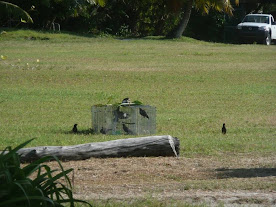
That day though, I was particularly interested in the behaviour of one bird that appeared to be exhibiting “scrape-making” behaviour. This is the precursor to egg laying and of course a very exciting development for the project. The bird stayed on the ground for more than 40 minutes and was twice attended by another bird – perhaps its mate? See photos in side bar which, although somewhat overexposed (it was a very bright sunny day) and taken at the maximum zoom nevertheless, serve to show the birds on the ground in amongst the models. The bird was down on its chest and displayed the rocking side-to-side motion that accompanies the activity of making a scrape in the ground that it will later lay in. I was not though, due to the lie of the land, able to see whether the bird’s feet were in fact scraping at the ground in order to make a depression. Notably having a left a bird (presumably the same one) did later return to the exact same location. So fingers crossed!
That however is just the least of it! On the morning of Wednesday the 24th June I received a call from the volunteers advising me that 20 birds had been on the ground that morning and that they had observed 3 pairs mating. This is very encouraging and caused me to advise several interested parties including Prof. Feare in UK accordingly.
We are of course still learning as we go; such a project has never been attempted with Sooty terns before and we are continuing to refine the methodology as we progress. These developments however constitute a major advance and give us hope for the future even if this year we do not have birds attempting breed on the site.
Time will tell… check back regularly for updates.
I paid a 24-hour visit to the island, weekend before last, in order to show some representatives of a potential donor agency the ongoing environmental work on Denis and also highlight some aspects that may be of interest to their organisation.
I made a special effort however to follow up on the sooty tern project during the visit and see how work is progressing and have some very encouraging news to recount.
I observed several birds circling very low over the project area and calling and also observed 3 birds landing. As we have seen before single birds that land, bow and display to the models but of course the models do not respond. However when they land in groups they can display to each other and this is our hope that sufficient birds can be attracted simultaneously down to the site such that they can cross-stimulate each other and begin the formation of a breeding colony.
That day though, I was particularly interested in the behaviour of one bird that appeared to be exhibiting “scrape-making” behaviour. This is the precursor to egg laying and of course a very exciting development for the project. The bird stayed on the ground for more than 40 minutes and was twice attended by another bird – perhaps its mate? See photos in side bar which, although somewhat overexposed (it was a very bright sunny day) and taken at the maximum zoom nevertheless, serve to show the birds on the ground in amongst the models. The bird was down on its chest and displayed the rocking side-to-side motion that accompanies the activity of making a scrape in the ground that it will later lay in. I was not though, due to the lie of the land, able to see whether the bird’s feet were in fact scraping at the ground in order to make a depression. Notably having a left a bird (presumably the same one) did later return to the exact same location. So fingers crossed!
That however is just the least of it! On the morning of Wednesday the 24th June I received a call from the volunteers advising me that 20 birds had been on the ground that morning and that they had observed 3 pairs mating. This is very encouraging and caused me to advise several interested parties including Prof. Feare in UK accordingly.
We are of course still learning as we go; such a project has never been attempted with Sooty terns before and we are continuing to refine the methodology as we progress. These developments however constitute a major advance and give us hope for the future even if this year we do not have birds attempting breed on the site.
Time will tell… check back regularly for updates.
Tuesday, June 9, 2009
Sooty tern project – update and Post by Prof. Chris Feare
I have been to the island 3 times in as many weeks largely due to the need to follow up on preparations for and implementation of the island’s sooty tern project (see my post of 19th May for background information). Professor Chris Feare, the world expert on the species, is in the Seychelles at the moment having come out to oversee the project set-up on Denis. Our two volunteers, Georgia French and Vicki Willits, have also arrived and work is now ongoing.
Following on from our findings last year the models and loud speakers have been set out in the project area. One loud speaker has also been mounted half-way up the trunk of a coconut tree facing out to sea along the prepared entry flight path in order to attract birds that may be flying along the coastline. The southeast monsoon has been late to establish this year and this has a bearing upon the behaviour of Sooty terns – with fewer birds over-flying the island than we would normally expect. The wind has however now set in and we hope that bird numbers will pick up in the next week or two. Despite this, landings have been relatively good with in fact more landings reported in the first week of work this year than throughout the entire season last year! This is very encouraging and underlines I feel, that the lessons learnt regarding the birds’ preferences last year are now reaping benefits in our work. Of particular note was the landing of a pair of birds which then commenced a courting display – exactly what we are hoping for!!!
Chris Feare has kindly written a post (see below) for this blog that sets our work in the broader context of his long term study of Sooty terns in the Seychelles archipelago:
"While Sooty Terns do not command the iconic status bestowed upon some of Seychelles’ rare endemic birds, such as the Seychelles Magpie Robin, Seychelles Warbler and Seychelles Paradise Flycatcher, the Sooty Tern is in fact the Seychelles’ most numerous bird. It breeds in huge spectacular colonies on Bird and Aride Islands, and on the more remote islands of Desnoeufs in the Amirantes, Goelette Island of Farquhar Atoll and Wizard Island of Cosmoledo Atoll. Despite remaining so numerous, Sooty Terns have faced a number of threats since man settled the islands in the mid-eighteenth century. These include the collecting of enormous numbers of their eggs, alteration of the habitats of their nesting islands and the introduction of mammalian predators such as rats and cats. As a result, several former breeding colonies now lie deserted, particularly those on smaller islands close to the main centres of human occupation.
Concern for the species led to their receiving various forms of protection but these are extremely difficult to enforce on remote and often uninhabited islands, and some of the earlier conservation attempts were based on insufficient knowledge of the birds’ biology and behaviour. My own studies of Sooty Terns in Seychelles, now spanning 37 years, along with investigations of colonies elsewhere in tropical oceans, have provided information on their needs and lifestyle that can contribute greatly to their conservation. For example, we know from recent events on Bird Island that restoration of prime habitat, by removing old coconut plantations and encouraging the development of indigenous herb vegetation such as purslane, can lead to a dramatic recovery in numbers. Controlled harvesting of their eggs can also play a part by placing a value on the birds while at the same time regulating the number of eggs that can be taken and the islands upon which harvest is permitted. And eradication of alien predators benefits all indigenous animals, not just Sooty Terns.
Sooty Terns are long-lived birds: on Bird Island ringing studies have revealed several birds 34 years old. In the absence of disturbance, adults usually return to nest on the same island year after year. In an attempt to re-establish a colony on an island known to have supported a large colony 200 years ago, an experiment is currently taking place on Denis Island (see recent blogs). Here, a small area of forest has been cleared and plastic models and broadcasts of Sooty Tern calls are being used, with some success, to attract birds to the island. Once settled, we hope they will continue to return and breed.
Despite our increased knowledge, however, Sooty Terns still hold many mysteries. In particular, we do not know where they feed while they are breeding. Nor do we know where they go when the leave Seychelles after breeding. Ring recoveries in southern India and in northern Australia suggest that they travel far. But we shall not get a better picture of their movements until tiny satellite transmitters, suitable for attachment to Sooty Terns, are available. Only then will we be able to determine whether another of man’s activities, intensive fishing of tuna, presents a threat to these magnificent birds. Sooty Terns do not eat tuna, but they are totally reliant on these predatory fish to drive smaller fish, like sardines, to the ocean surface where they become available to the birds. So if the Sooties prove to feed where tuna are being over-fished, the birds’ populations will be threatened no matter what conservation measures are in place on their nesting islands."
Following on from our findings last year the models and loud speakers have been set out in the project area. One loud speaker has also been mounted half-way up the trunk of a coconut tree facing out to sea along the prepared entry flight path in order to attract birds that may be flying along the coastline. The southeast monsoon has been late to establish this year and this has a bearing upon the behaviour of Sooty terns – with fewer birds over-flying the island than we would normally expect. The wind has however now set in and we hope that bird numbers will pick up in the next week or two. Despite this, landings have been relatively good with in fact more landings reported in the first week of work this year than throughout the entire season last year! This is very encouraging and underlines I feel, that the lessons learnt regarding the birds’ preferences last year are now reaping benefits in our work. Of particular note was the landing of a pair of birds which then commenced a courting display – exactly what we are hoping for!!!
Chris Feare has kindly written a post (see below) for this blog that sets our work in the broader context of his long term study of Sooty terns in the Seychelles archipelago:
"While Sooty Terns do not command the iconic status bestowed upon some of Seychelles’ rare endemic birds, such as the Seychelles Magpie Robin, Seychelles Warbler and Seychelles Paradise Flycatcher, the Sooty Tern is in fact the Seychelles’ most numerous bird. It breeds in huge spectacular colonies on Bird and Aride Islands, and on the more remote islands of Desnoeufs in the Amirantes, Goelette Island of Farquhar Atoll and Wizard Island of Cosmoledo Atoll. Despite remaining so numerous, Sooty Terns have faced a number of threats since man settled the islands in the mid-eighteenth century. These include the collecting of enormous numbers of their eggs, alteration of the habitats of their nesting islands and the introduction of mammalian predators such as rats and cats. As a result, several former breeding colonies now lie deserted, particularly those on smaller islands close to the main centres of human occupation.
Concern for the species led to their receiving various forms of protection but these are extremely difficult to enforce on remote and often uninhabited islands, and some of the earlier conservation attempts were based on insufficient knowledge of the birds’ biology and behaviour. My own studies of Sooty Terns in Seychelles, now spanning 37 years, along with investigations of colonies elsewhere in tropical oceans, have provided information on their needs and lifestyle that can contribute greatly to their conservation. For example, we know from recent events on Bird Island that restoration of prime habitat, by removing old coconut plantations and encouraging the development of indigenous herb vegetation such as purslane, can lead to a dramatic recovery in numbers. Controlled harvesting of their eggs can also play a part by placing a value on the birds while at the same time regulating the number of eggs that can be taken and the islands upon which harvest is permitted. And eradication of alien predators benefits all indigenous animals, not just Sooty Terns.
Sooty Terns are long-lived birds: on Bird Island ringing studies have revealed several birds 34 years old. In the absence of disturbance, adults usually return to nest on the same island year after year. In an attempt to re-establish a colony on an island known to have supported a large colony 200 years ago, an experiment is currently taking place on Denis Island (see recent blogs). Here, a small area of forest has been cleared and plastic models and broadcasts of Sooty Tern calls are being used, with some success, to attract birds to the island. Once settled, we hope they will continue to return and breed.
Despite our increased knowledge, however, Sooty Terns still hold many mysteries. In particular, we do not know where they feed while they are breeding. Nor do we know where they go when the leave Seychelles after breeding. Ring recoveries in southern India and in northern Australia suggest that they travel far. But we shall not get a better picture of their movements until tiny satellite transmitters, suitable for attachment to Sooty Terns, are available. Only then will we be able to determine whether another of man’s activities, intensive fishing of tuna, presents a threat to these magnificent birds. Sooty Terns do not eat tuna, but they are totally reliant on these predatory fish to drive smaller fish, like sardines, to the ocean surface where they become available to the birds. So if the Sooties prove to feed where tuna are being over-fished, the birds’ populations will be threatened no matter what conservation measures are in place on their nesting islands."
Tuesday, May 19, 2009
Sooty tern (Onychoprion fuscata) project – year 2
It’s getting round to that time of year again! I have just received a shipment of new models (see photo in sidebar) so we can increase the density of models in the trial area this year. These models are closer to the actual size of the Sooty tern and are in fact magpie models that have been re-painted to appear like Sooty terns. When Denis was first discovered in 1773 it hosted very large seabird colonies including a large population of Sooty tern. Human impact on the island over the next hundreds years was very extensive and it is likely that the ground nesting sea bird colonies were extirpated within that period.
The environmental management plan for Denis has set aside the southern portion of the island for restoration to as close as possible to how it was when first discovered. The attempt to re-establish a colony of Sooty terns on the island forms part of this initiative.
The project commenced last year (see my posts of 2nd July, 21st September and 13th October 2008 for more information) with the preparation of the habitat area and the trial of different habitat and stimuli combinations including 2D and 3D models and the broadcasting of colony noise from loud speakers.
The first year of work and its structured approach allowed us to learn a good deal about the preferences of the birds and the trial area will be set out this year to reflect those findings and we are optimistic about the potential for 2009.
We are working with Dr Chris Feare who is a leading ornithologist and has been working on Sooty terns in Seychelles for many years. Chris will be arriving at the end of this month along with a couple of volunteers who will assist with the monitoring of the scheme this year - as well as undertaking other work.
I will report regularly on the project and its progression – success is by no means guaranteed but we are again breaking new ground here on Denis Island and should we achieve our objective it would represent another world first for the island - so do keep checking back for news on the Sooty tern project over the coming weeks…
The environmental management plan for Denis has set aside the southern portion of the island for restoration to as close as possible to how it was when first discovered. The attempt to re-establish a colony of Sooty terns on the island forms part of this initiative.
The project commenced last year (see my posts of 2nd July, 21st September and 13th October 2008 for more information) with the preparation of the habitat area and the trial of different habitat and stimuli combinations including 2D and 3D models and the broadcasting of colony noise from loud speakers.
The first year of work and its structured approach allowed us to learn a good deal about the preferences of the birds and the trial area will be set out this year to reflect those findings and we are optimistic about the potential for 2009.
We are working with Dr Chris Feare who is a leading ornithologist and has been working on Sooty terns in Seychelles for many years. Chris will be arriving at the end of this month along with a couple of volunteers who will assist with the monitoring of the scheme this year - as well as undertaking other work.
I will report regularly on the project and its progression – success is by no means guaranteed but we are again breaking new ground here on Denis Island and should we achieve our objective it would represent another world first for the island - so do keep checking back for news on the Sooty tern project over the coming weeks…
Subscribe to:
Posts (Atom)




 Posts
Posts