Catherina, I and others are keeping our eyes peeled for migratory birds and so building on my first report (posted on October 5th) and in addition to the normal large numbers of whimbrel and turnstone, we have the following to report.
Ringed Plover (Charadrius hiaticula): a single bird seen in the hotel gardens, and on the east coast reef flats.
Grey Plover (Pluvialis squatarola): total numbers of wading birds of any particular species round the island are very difficult to estimate as the birds are often dispersed around the coast and are of course much more mobile than your average observer. It is clear however we have several grey plovers (5-6) on the island at this time.
Crab Plover (Dromas ardeola): there are at least 2 and possibly as many as 4 of these elegant birds on the island being most commonly seen around Pointe l’Est
Gull-billed tern (Gelochelidon nilotica): During the 9th and 10th of October I observed 1 bird on three separate occasions flying quite low over the coast, twice around Pte Mme Guichard and once on the west coast by the runway.
Catherina has two interesting records of a European turtle dove (Streptopelia picturata) on the 5th of October and a Common pratincole (Glareola pratincola) on the 6th.
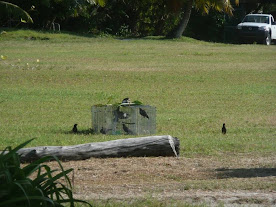
Finally Mr Mickey Mason, an island resident, spotted mid-month an unusual visitor along the coast and was able to take some photos from a distance (see sidebar), as per his own description:
“I found a tern last weekend flying over the beach and diving for food amongst weed and debris. It has graceful flight but quite agile, turns sharply to dive and hover above the beach when it has noticed something of interest. Looks like a type of Marsh tern[1]… sorry about the photo quality.”
This information and the photos of the bird have been forwarded to Mr. Adrian Skerrett of the Seychelles Bird Record Committee (see link in sidebar) in the hope that it may be possible to make a verified identification.
[1] (a) Chlidonias hybridus: whiskered or marsh tern; (b) Chlidonias leucopterus: white-winged or marsh tern
Friday, October 31, 2008

Tuesday, October 28, 2008
Fairy Tern and Tropicbird Progress (4).
As usual the first thing I checked on arrival on Thursday 23rd was the status of the three fairy tern juveniles that I have been following over the preceding weeks and reporting on in the earlier editions of this post.
• As with two weeks ago the first juvenile looks fully developed except for the lack of the purple colouration at the base of its bill. I am becoming a little concerned however that this bird is always on its perch. I have yet to see it fly and does seem rather passive. Those of you that have followed the earlier posts on this topic will recall that I started these observations because an unusually high number of fairy tern chicks seemed to be dying around the island in the preceding months suggesting perhaps that there was a food shortage. I do hope that this bird is not following that route.
• The second chick that we have followed since hatchling is progressing well. As reported 2 weeks ago it is alert and already flying. Its plumage has further developed in the interim and the juvenile barring on the wings is becoming less prominent.
• Our third chick “Fred” which we have been following since it was an egg(!) is also showing good growth and development, “he” is very alert and has taken to moving up and down his branch. The plumage however is still very much that of a chick.
Moving on to the Tropicbirds I have very encouraging news:
• The first nest site that had been unoccupied during my checks over the last four weeks again has an adult in place – so let’s hope for an egg this time!
• The adult is still present at the second site and I have still been unable to determine if there is an egg being incubated – the single large brick-red egg typically takes some 6 weeks to hatch and is incubated in turn by both parents.
• Tina our chick appears very well, she is alert appears in good condition and has grown significantly such that the first proper juvenile plumage with black barring is now evident (see photo in sidebar).
Check back regularly for further updates on Fred and Tina’s progress.
• As with two weeks ago the first juvenile looks fully developed except for the lack of the purple colouration at the base of its bill. I am becoming a little concerned however that this bird is always on its perch. I have yet to see it fly and does seem rather passive. Those of you that have followed the earlier posts on this topic will recall that I started these observations because an unusually high number of fairy tern chicks seemed to be dying around the island in the preceding months suggesting perhaps that there was a food shortage. I do hope that this bird is not following that route.
• The second chick that we have followed since hatchling is progressing well. As reported 2 weeks ago it is alert and already flying. Its plumage has further developed in the interim and the juvenile barring on the wings is becoming less prominent.
• Our third chick “Fred” which we have been following since it was an egg(!) is also showing good growth and development, “he” is very alert and has taken to moving up and down his branch. The plumage however is still very much that of a chick.
Moving on to the Tropicbirds I have very encouraging news:
• The first nest site that had been unoccupied during my checks over the last four weeks again has an adult in place – so let’s hope for an egg this time!
• The adult is still present at the second site and I have still been unable to determine if there is an egg being incubated – the single large brick-red egg typically takes some 6 weeks to hatch and is incubated in turn by both parents.
• Tina our chick appears very well, she is alert appears in good condition and has grown significantly such that the first proper juvenile plumage with black barring is now evident (see photo in sidebar).
Check back regularly for further updates on Fred and Tina’s progress.
Sunday, October 26, 2008
Shear(water) Delight – Another first for Denis Island!!!
In previous posts (see August 18th and October 19th) I have written of the re-establishment of a small Wedge-tailed shearwater (Puffinus pacificus) colony on Denis and the significance this has as an indicator of the rehabilitation of the island’s ecosystem since the rat eradication of 2002. As of November 2007, a small colony of burrows was found on the east coast of the island but at that time I was unable to find proof of breeding activity. The shearwater may breed at any time but shows a distinct peak in breeding activity September through February. I have, therefore, been monitoring the burrows closely over the last 4-6 weeks in the hope of finding evidence of breeding and thereby prove the species is indeed once again established on Denis.
So I am very happy to relate that on Thursday 23rd October I found, and was able to photograph (see photos in sidebar), an adult shearwater incubating an egg in one of the burrows!!! This therefore now verifiably proves that the species has established a small breeding colony on the island – yet another exciting landmark for Denis.
Skerrett et al (2001) state of wedge-tailed shearwaters that:
“Sexes share incubation, each shift lasting several days. Incubation usually takes 50-54… and chicks fledge after three months.”
I will continue to keep a close eye on our small colony in the coming weeks and hopefully in due course I will be able to find more eggs and record the subsequent chicks. So keep checking back for updates!
It doesn’t stop there however, Mr Paul Horner the hotel manager, has advised me that in recent days he has twice had call to remove from the hotel restaurant what, as per his description, sounds very much like an Audubon’s shearwater (Puffinus lherminieri); the bird having become confused by the restaurant lights. I have asked him to photograph the bird should the incident reoccur as if it can be confirmed as an Audubon’s this would suggest that this species may also now be roosting on the island!!!
Skerrett et al (2001): Birds of Seychelles. Christopher Helm (publishers) Ltd. London.
So I am very happy to relate that on Thursday 23rd October I found, and was able to photograph (see photos in sidebar), an adult shearwater incubating an egg in one of the burrows!!! This therefore now verifiably proves that the species has established a small breeding colony on the island – yet another exciting landmark for Denis.
Skerrett et al (2001) state of wedge-tailed shearwaters that:
“Sexes share incubation, each shift lasting several days. Incubation usually takes 50-54… and chicks fledge after three months.”
I will continue to keep a close eye on our small colony in the coming weeks and hopefully in due course I will be able to find more eggs and record the subsequent chicks. So keep checking back for updates!
It doesn’t stop there however, Mr Paul Horner the hotel manager, has advised me that in recent days he has twice had call to remove from the hotel restaurant what, as per his description, sounds very much like an Audubon’s shearwater (Puffinus lherminieri); the bird having become confused by the restaurant lights. I have asked him to photograph the bird should the incident reoccur as if it can be confirmed as an Audubon’s this would suggest that this species may also now be roosting on the island!!!
Skerrett et al (2001): Birds of Seychelles. Christopher Helm (publishers) Ltd. London.
Wednesday, October 22, 2008
The Hawksbill Turtle Season Begins…
When Denis De Trobriand discovered Denis in 1773 he described turtles as abundant in the waters around the island. Two species of turtle are still to be found nesting on Denis today – if in much reduced numbers from the abundant days of De Trobriand.
The Green turtle (Chelonia mydas) nests on Denis in small numbers year round with a peak of activity in April through June. The Hawksbill turtle (Eretmochelys imbricata) has a much more distinct nesting season (October – February) which is now commencing on Denis.
The hawksbill is classified as critically endangered by the World Conservation Union and Seychelles is one of the best five remaining locations in the world for the species (Meylan & Donnelly 1999).
Threatened by hunting for its shell (known as tortoiseshell) and loss of habitat – most critically nesting habitat – the hawksbill has received full protection under the law in Seychelles since 1994. Despite the success of certain protected area nesting sites the overall population has continued to decline (Mortimer 2004) with loss of nesting habitat to tourism development and activity being considered the primary ongoing problem.
Denis Island is member of the “Turtle Action Group Seychelles” (TAGS) which is a newly-formed association of some 14 agencies that manage turtle rookeries (nesting areas). As a requirement of its membership Denis must collect information on its nesting turtle populations and submit it to a national stakeholder database operated by TAGS. Data has been collected in the past on nesting turtles but limited human capacity has and continues to be the primary constraint to the consistent collection of standardised data. During the peak of the season thorough monitoring on Denis would entail at least two people working full-time. It is hoped that for season commencing in 2009 that designated accommodation will be available on the island to enable basic but thorough data collection to be undertaken by volunteers.
In the meantime however efforts will be made to gather the most basic form of data through the counting of tracks on the beach. Although turtles by no means nest successfully every time they come ashore the body of work by Dr Jeanne Mortimer has enabled a ratio of beachings per nest to be established for the Seychelles hawksbill population and this can be used to estimate the number of females actually nesting on Denis.
I will in due course periodically report on the progress of the season and set this in the context of management measures. This information will help guide management activity on the island and identify issues to be mitigated in order to optimise the breeding success of the hawksbill rookery on Denis. So check back regularly for news on the season as it progresses!
Meylan, A.B. & Donnelly, M. (1999). Status and justification for listing the hawksbill turtle (Eretmochelys imbricata) as Critically Endanagered on the 1996 IUCN Red List of Threatened animals. Chelonian Conserbvation and Biology 3 (2): 200 – 224.
Mortimer, J.A. 2004. Seychelles Marine Ecosystem Management Project (SEYMEMP): Turtle Component. Final Report. Vol 1: Text, 243 pages. Vol 2: Appendix 1-11, 158 pages.
The Green turtle (Chelonia mydas) nests on Denis in small numbers year round with a peak of activity in April through June. The Hawksbill turtle (Eretmochelys imbricata) has a much more distinct nesting season (October – February) which is now commencing on Denis.
The hawksbill is classified as critically endangered by the World Conservation Union and Seychelles is one of the best five remaining locations in the world for the species (Meylan & Donnelly 1999).
Threatened by hunting for its shell (known as tortoiseshell) and loss of habitat – most critically nesting habitat – the hawksbill has received full protection under the law in Seychelles since 1994. Despite the success of certain protected area nesting sites the overall population has continued to decline (Mortimer 2004) with loss of nesting habitat to tourism development and activity being considered the primary ongoing problem.
Denis Island is member of the “Turtle Action Group Seychelles” (TAGS) which is a newly-formed association of some 14 agencies that manage turtle rookeries (nesting areas). As a requirement of its membership Denis must collect information on its nesting turtle populations and submit it to a national stakeholder database operated by TAGS. Data has been collected in the past on nesting turtles but limited human capacity has and continues to be the primary constraint to the consistent collection of standardised data. During the peak of the season thorough monitoring on Denis would entail at least two people working full-time. It is hoped that for season commencing in 2009 that designated accommodation will be available on the island to enable basic but thorough data collection to be undertaken by volunteers.
In the meantime however efforts will be made to gather the most basic form of data through the counting of tracks on the beach. Although turtles by no means nest successfully every time they come ashore the body of work by Dr Jeanne Mortimer has enabled a ratio of beachings per nest to be established for the Seychelles hawksbill population and this can be used to estimate the number of females actually nesting on Denis.
I will in due course periodically report on the progress of the season and set this in the context of management measures. This information will help guide management activity on the island and identify issues to be mitigated in order to optimise the breeding success of the hawksbill rookery on Denis. So check back regularly for news on the season as it progresses!
Meylan, A.B. & Donnelly, M. (1999). Status and justification for listing the hawksbill turtle (Eretmochelys imbricata) as Critically Endanagered on the 1996 IUCN Red List of Threatened animals. Chelonian Conserbvation and Biology 3 (2): 200 – 224.
Mortimer, J.A. 2004. Seychelles Marine Ecosystem Management Project (SEYMEMP): Turtle Component. Final Report. Vol 1: Text, 243 pages. Vol 2: Appendix 1-11, 158 pages.
Sunday, October 19, 2008
Denis Island turns the corner…
This blog is one means of publicising the work Denis Island Development (Pty) Limited and GIF are undertaking, on Denis Island. The web is not available to all however and as such we also utilise other media to raise awareness and share information with stakeholders, interested parties and the general public. The article below is published in today’s (October 20th) Seychelles Nation newspaper. I have also posted a photo of the article below – click on this photo to see the article and its images in full size.

Denis Island turns the corner…
Denis Island began its ecosystem restoration programme 10 years ago when it undertook a preliminary alien mammal species assessment. Cats were subsequently eradicated in 2000 and rats in 2002. This is very important as Seychelles naturally has no terrestrial mammals, except for two species of bat, and the fauna and flora of the islands have evolved therefore without the necessary adaptations to cope with the impacts of animals such as rats, cats, pigs and goats. Today Denis represents 17.5% of the rat-free land in the central archipelago and is thus vital to several national conservation initiatives.
Denis Island has embraced stakeholder partnership as a means of furthering its own and national environmental objectives. In 1999-2001 Denis worked with Nature Seychelles to rehabilitate 35 hectares of broadleaved woodland habitat on the island in order to enable the introduction of rare endemic birds. In 2004 the rare Seychelles fody and Seychelles warbler were introduced and monitoring over subsequent years has shown that the populations have established well and are expanding. Then in June of this year, again in partnership with Nature Seychelles, 20 endangered Magpie robins were introduced and here too progress is very encouraging with island’s first fledgling developing well.
In 2006 Denis signed an agreement with the Green Islands Foundation (GIF), a local NGO, to develop an environmental management plan and provide technical support for its environmental initiatives. Since that time GIF has initiated various programmes on Denis, developed the island’s ecotourism product and established various databases. The monitoring undertaken has come at a crucial time and has recorded some major landmarks in the natural recovery of the island’s ecosystem post the 2002 rat eradication.
Over the last year Frigate birds have established a regular roost on the island with up to 50 birds being recorded; and a relatively large roost (200 – 300) of Bridled terns has also started to utilise the island out of breeding season.
Ground nesting seabirds are particularly vulnerable to rats and cats and so seabird occurrence has been monitored closely. In November of 2007 there was a most encouraging discovery of a small colony of wedge-tailed shearwaters. This bird excavates burrows underground in which to roost and breed. The new colony consists of only 20 or so burrows but has expanded over the last year and represents a major breakthrough in the recovery of the island’s ecosystem.Over the last 3 years a few pairs of white-tailed tropicbird have been noted to breed on the island in some tree cavities and also one high up in the lighthouse! What was really awaited however, was the first occurrence of ground nesting. Then last month, having seen none over the preceding 3 years, 3 adults were found nesting on the ground within 24 hours and the island now has its first tropicbird chick in a ground nest!!
These discoveries are fantastic news as they really show that the island has turned a corner in its recovery such that wild species like the shearwater and tropicbird are once again finding it suitable to establish colonies.
These developments are the fruit of 10 years of work and investment by Denis Island and show that man can work to restore island ecosystems and furthermore do so within the context of tourism and landscape production activities. This progress demonstrates that development and conservation can be undertaken side-by-side and indeed in the case of Denis can be considered interdependent. After all it is the revenue from the tourism development and landscape production activities that subsidises the rehabilitation and conservation programmes. Now these programmes have in turn resulted in a healthy and more productive ecosystem and an enriched ecotourism product for the resort.

Denis Island turns the corner…
Denis Island began its ecosystem restoration programme 10 years ago when it undertook a preliminary alien mammal species assessment. Cats were subsequently eradicated in 2000 and rats in 2002. This is very important as Seychelles naturally has no terrestrial mammals, except for two species of bat, and the fauna and flora of the islands have evolved therefore without the necessary adaptations to cope with the impacts of animals such as rats, cats, pigs and goats. Today Denis represents 17.5% of the rat-free land in the central archipelago and is thus vital to several national conservation initiatives.
Denis Island has embraced stakeholder partnership as a means of furthering its own and national environmental objectives. In 1999-2001 Denis worked with Nature Seychelles to rehabilitate 35 hectares of broadleaved woodland habitat on the island in order to enable the introduction of rare endemic birds. In 2004 the rare Seychelles fody and Seychelles warbler were introduced and monitoring over subsequent years has shown that the populations have established well and are expanding. Then in June of this year, again in partnership with Nature Seychelles, 20 endangered Magpie robins were introduced and here too progress is very encouraging with island’s first fledgling developing well.
In 2006 Denis signed an agreement with the Green Islands Foundation (GIF), a local NGO, to develop an environmental management plan and provide technical support for its environmental initiatives. Since that time GIF has initiated various programmes on Denis, developed the island’s ecotourism product and established various databases. The monitoring undertaken has come at a crucial time and has recorded some major landmarks in the natural recovery of the island’s ecosystem post the 2002 rat eradication.
Over the last year Frigate birds have established a regular roost on the island with up to 50 birds being recorded; and a relatively large roost (200 – 300) of Bridled terns has also started to utilise the island out of breeding season.
Ground nesting seabirds are particularly vulnerable to rats and cats and so seabird occurrence has been monitored closely. In November of 2007 there was a most encouraging discovery of a small colony of wedge-tailed shearwaters. This bird excavates burrows underground in which to roost and breed. The new colony consists of only 20 or so burrows but has expanded over the last year and represents a major breakthrough in the recovery of the island’s ecosystem.Over the last 3 years a few pairs of white-tailed tropicbird have been noted to breed on the island in some tree cavities and also one high up in the lighthouse! What was really awaited however, was the first occurrence of ground nesting. Then last month, having seen none over the preceding 3 years, 3 adults were found nesting on the ground within 24 hours and the island now has its first tropicbird chick in a ground nest!!
These discoveries are fantastic news as they really show that the island has turned a corner in its recovery such that wild species like the shearwater and tropicbird are once again finding it suitable to establish colonies.
These developments are the fruit of 10 years of work and investment by Denis Island and show that man can work to restore island ecosystems and furthermore do so within the context of tourism and landscape production activities. This progress demonstrates that development and conservation can be undertaken side-by-side and indeed in the case of Denis can be considered interdependent. After all it is the revenue from the tourism development and landscape production activities that subsidises the rehabilitation and conservation programmes. Now these programmes have in turn resulted in a healthy and more productive ecosystem and an enriched ecotourism product for the resort.
Thursday, October 16, 2008
Tori’s View.
I have received word from our volunteers Tori Yates and Vicki Wheeler who have graduated from their course with distinction so congratulations to them both!!! Tori has been kind enough to write a post about her time on the island which I attach below.
From May to July 2008 my colleague, Vicki wheeler, and I worked on Denis Island as Volunteers for the Green Islands Foundation. Sitting now in my flat in Reading, UK; Denis seems a million miles away! Vicki and I worked on two projects on the island:
· a project to re-establish a sooty tern colony, and
· a project to investigate the hermit crab populations on the island their status and habitat associations.
These projects contributed to our MSc studies on Wildlife Management and Conservation at the University of Reading.
We arrived on Denis at the end of May with Professor Chris Feare, a leading expert on the Sooty tern with a long working experience of the species in Seychelles, to set up the sooty tern project.
To try to lure the birds we used a mixture of 3D, 2D models and loud speakers that played the colony noise of Sooty Terns. Similar projects had been undertaken in the past in North America on Least Terns and Arctic Terns but it had never been tried with Sooty Terns before. The experimental site was set up on the south of the island in an area of cleared coconut trees as Sooty Terns nest on the ground. During the two months we were on the island a total of 24 birds landed in the experimental site and exhibited a 95.7% preference for a specific combination of models and vegetation type. These highly significant findings on preference will allow a much more targeted management of the area during the second season of the project. The impact of broadcasting colony noise was vital as 100% of circling behaviour and bird landings occurred when the speakers were playing the colony noise. At the end of the nesting season the site was rearranged into a tighter knit colony using half of the available space. 30 of the models were painted with juvenile markings and these were interspersed with the adult models. This was to make the site look appealing to overflying or “prospecting” birds looking for a nesting site for the next year. (Ed: I was supposed to follow up on this the next month but unfortunately broke my arm and was unable to undertake the work. Occasional observations by others, however, suggest that this reformulation was very successful in attracting groups of birds to the area – see posts of 13th October and 21st September). The Sooty Tern colony experiment will run in 2009 and I am very hopeful that next year more birds will come to the site and a colony will be established.
While we were on the island Vicki and I also undertook a study of the hermit crab populations, so if you visit Denis and see crabs with numbers on their shells, this is not a strange phenomenon, but rather us giving each crab we found a unique number. Little was known about the hermit crabs on the island, and while we were there we found there are three species and they all prefer the native coastal vegetation. Vicki and I had a fabulous time on the island and we were really happy to have helped the GIF and the owners of the island find out more about the wildlife they have on Denis. While we were on the island, Vicki and I worked really hard, going out and sampling crabs or monitoring the Sooty Tern site everyday but we greatly enjoyed the experience and I know that we would both like to return to the island in the next couple of years when hopefully there will be a thriving Sooty Tern colony! We would like to thank in particular Mr and Mrs Mason for their hospitality by allowing us to live and work on their island, and also John Nevill for all the assistance he gave us while we were on Denis.
From May to July 2008 my colleague, Vicki wheeler, and I worked on Denis Island as Volunteers for the Green Islands Foundation. Sitting now in my flat in Reading, UK; Denis seems a million miles away! Vicki and I worked on two projects on the island:
· a project to re-establish a sooty tern colony, and
· a project to investigate the hermit crab populations on the island their status and habitat associations.
These projects contributed to our MSc studies on Wildlife Management and Conservation at the University of Reading.
We arrived on Denis at the end of May with Professor Chris Feare, a leading expert on the Sooty tern with a long working experience of the species in Seychelles, to set up the sooty tern project.
To try to lure the birds we used a mixture of 3D, 2D models and loud speakers that played the colony noise of Sooty Terns. Similar projects had been undertaken in the past in North America on Least Terns and Arctic Terns but it had never been tried with Sooty Terns before. The experimental site was set up on the south of the island in an area of cleared coconut trees as Sooty Terns nest on the ground. During the two months we were on the island a total of 24 birds landed in the experimental site and exhibited a 95.7% preference for a specific combination of models and vegetation type. These highly significant findings on preference will allow a much more targeted management of the area during the second season of the project. The impact of broadcasting colony noise was vital as 100% of circling behaviour and bird landings occurred when the speakers were playing the colony noise. At the end of the nesting season the site was rearranged into a tighter knit colony using half of the available space. 30 of the models were painted with juvenile markings and these were interspersed with the adult models. This was to make the site look appealing to overflying or “prospecting” birds looking for a nesting site for the next year. (Ed: I was supposed to follow up on this the next month but unfortunately broke my arm and was unable to undertake the work. Occasional observations by others, however, suggest that this reformulation was very successful in attracting groups of birds to the area – see posts of 13th October and 21st September). The Sooty Tern colony experiment will run in 2009 and I am very hopeful that next year more birds will come to the site and a colony will be established.
While we were on the island Vicki and I also undertook a study of the hermit crab populations, so if you visit Denis and see crabs with numbers on their shells, this is not a strange phenomenon, but rather us giving each crab we found a unique number. Little was known about the hermit crabs on the island, and while we were there we found there are three species and they all prefer the native coastal vegetation. Vicki and I had a fabulous time on the island and we were really happy to have helped the GIF and the owners of the island find out more about the wildlife they have on Denis. While we were on the island, Vicki and I worked really hard, going out and sampling crabs or monitoring the Sooty Tern site everyday but we greatly enjoyed the experience and I know that we would both like to return to the island in the next couple of years when hopefully there will be a thriving Sooty Tern colony! We would like to thank in particular Mr and Mrs Mason for their hospitality by allowing us to live and work on their island, and also John Nevill for all the assistance he gave us while we were on Denis.
Wednesday, October 15, 2008
Bird Bulletin 8
Crested Terns. These beautiful birds are still with us and indeed I recorded my highest count for Denis yet, on Friday 10th October, with 14 birds perched on the southern rocks.
Bridled (re)Terns. Having recorded a bridled tern roost of 200 – 300 birds on the island October through December last year, I have been on the look out at the southern point of the island where the bulk aggregated last year but without success. Then on Saturday 11th I was undertaking the first beach check of the new hawksbill turtle season when I noticed all five buoys off the west of the island were being used as perches by bridled terns. This gave an inclination that birds might be returning and sure enough further down the coast in the branches of a prominent casuarina tree I counted 15 bridled terns and 10 lesser noddies. The southern point of the island however still shows no sign of bridled terns and so I will keep monitoring this small roost area to see if it expands as the weeks pass.
Frigate birds. I have still to go and check properly on our Frigate bird roost as the right time usually clashes with other commitments but on the evening of Friday 10th I saw 29 Frigates flying very low over the island towards their southwest coast roost area.
Blue pigeons. I have written at length on the blue pigeons on the island in other posts (most notably the August 10th post entitled “Natural Recolonisation 1”) and the population continues to do very well. On Saturday 11th I saw two fledglings together accompanied by an adult in a small Morinda tree. The various ornithological reference works do state that the birds will occasionally have a clutch of two eggs, though I have personally never seen this, but this sighting seems to suggest the successful fledging of a clutch of 2 on Denis.
King Myna. The Myna birds on Denis have taken to imitating the call of the Magpie robins already causing me stop more frequently to verify whether I am indeed hearing a robin or not. I have also seen on 3 or 4 occasions recently, at Belle Etoile, what is known as a “King Myna” – i.e. a Myna bird which has no feathers on its head or neck thus revealing the yellow skin all over its head to quite startling effect.
Bridled (re)Terns. Having recorded a bridled tern roost of 200 – 300 birds on the island October through December last year, I have been on the look out at the southern point of the island where the bulk aggregated last year but without success. Then on Saturday 11th I was undertaking the first beach check of the new hawksbill turtle season when I noticed all five buoys off the west of the island were being used as perches by bridled terns. This gave an inclination that birds might be returning and sure enough further down the coast in the branches of a prominent casuarina tree I counted 15 bridled terns and 10 lesser noddies. The southern point of the island however still shows no sign of bridled terns and so I will keep monitoring this small roost area to see if it expands as the weeks pass.
Frigate birds. I have still to go and check properly on our Frigate bird roost as the right time usually clashes with other commitments but on the evening of Friday 10th I saw 29 Frigates flying very low over the island towards their southwest coast roost area.
Blue pigeons. I have written at length on the blue pigeons on the island in other posts (most notably the August 10th post entitled “Natural Recolonisation 1”) and the population continues to do very well. On Saturday 11th I saw two fledglings together accompanied by an adult in a small Morinda tree. The various ornithological reference works do state that the birds will occasionally have a clutch of two eggs, though I have personally never seen this, but this sighting seems to suggest the successful fledging of a clutch of 2 on Denis.
King Myna. The Myna birds on Denis have taken to imitating the call of the Magpie robins already causing me stop more frequently to verify whether I am indeed hearing a robin or not. I have also seen on 3 or 4 occasions recently, at Belle Etoile, what is known as a “King Myna” – i.e. a Myna bird which has no feathers on its head or neck thus revealing the yellow skin all over its head to quite startling effect.
Subscribe to:
Posts (Atom)




 Posts
Posts