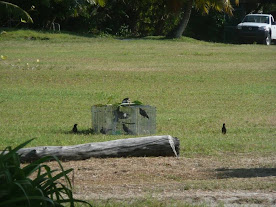
I received earlier today a call from Catherina on the island telling me that she had sent an e-mail with photos of an adult female SMR that was showing signs of ill-health. The posture, plumage and behaviour of the bird were not good and furthermore its droppings were liquid.
E-mail communications followed with Rachel Bristol and I then spoke with Dr Melanie to the vets department on Mahe. It was decided to get a broad-spectrum antibiotic that could be administered by injection to the bird. So I then went to the vets department purchased a bottle of Oxytetracycline and the smallest syringes and needles available.
The treatment entails capturing the bird and injecting 0.1ml into the bird’s muscle tissue and repeat in 3 days or so. This method has been used successfully previously on SMRs. So it is to be hoped that this problem is based upon a bacterial infection and that the treatment reaps benefits.
Unfortunately by the time I got the call from Catherina it was already too late to catch the plane and there being no flight on Wednesday we will not be able to get the medicine to the island before Thursday – hopefully it won’t be too late.
The tetracycline has a long shelf life so we can keep it in the fridge on Denis for about a year and use it on other birds should the need arise.
Check back regularly for news on our poorly magpie-robin.
Tuesday, May 19, 2009

Thursday, May 14, 2009
The Seychelles Flycatcher (Terpsiphone corvina): whiskers, “hair-dos” and mimicry…
In my post of 9th April I wrote about the whiskers clearly evident on the faces of both male and female flycatchers (Terpsiphone corvina) and postulated on what their purpose might be. Whilst drafting that post I spoke to Rachel Bristol, Project Officer on the Flycatcher project. We talked about the whiskers and Rachel also commented on head plumage of the birds referring to it in her inimitable style as a “spiky hair-do”. Rachel subsequently sent me a wonderful photo of a male flycatcher in hand which clearly illustrates both features (see sidebar).
Then after her last visit to Denis, Rachel called to update me on her findings and mentioned something new of real interest namely that the Seychelles magpie robins (Copsychus sechellarum) in some territories had begun to imitate the song of the Flycatcher.
I have in the past written about the ability of Mynah birds to mimic the calls of the Seychelles magpie robin on Denis. The Mynah is a renowned mimic and I would not have been at all surprised if they had already begun copying the Flycatcher’s call and causing confusion in Rachel’s attempt to monitor the flycatchers on Denis. The Seychelles magpie robin is another matter and this is of particular interest because until the introduction of Flycatchers to Denis in November the two species had not co-existed on an island for a hundred years or more. This co-existence is therefore a new experience for the all the birds and also a time of great interest for ornithologists to see how the two species will interact. The feeding niche of the two species is largely distinct and their territories overlay each other on Denis without any evidence of negative interaction but the Magpie robins adopting the song of the flycatcher may conceivably lead to some confrontations in territories – at least in the short term
I was involved with the transfer of Magpie robins to Cousine Island in 1995. The overall population was much lower back then and the habitat on Cousine despite my efforts over the preceding year or two was still limited for the species. As such a very precautionary approach to the introduction was undertaken - two young surplus males from Fregate were introduced to the island and latterly an old male which had been displaced from its territory on Fregate and following injury had been nursed back to health by hand. These birds were surplus and somewhat expendable and the intention was to see how they fared on Cousine before any precious females would be risked. (The birds did settle and the old one ended up fathering more offspring when females were latterly introduced). Initially however what was remarkable was the very limited song variety of the young males. One of them just continually repeating the same three note refrain until it would put one’s teeth on edge! When the old male was introduced however he had an extensive variety of tunes suggesting that birds acquire/learn new songs over time and are not born with a pre-programmed repertoire. This thought was re-enforced when the younger males began to expand their own tune list once the old male had been introduced.
Now here on Denis nearly 15 years later we have further evidence of the capacity of the Magpie robin to learn new tunes and styles.
Wednesday, May 13, 2009
Observations on the Seychelles blue pigeon (Alectroenas pulcherrima)
In my post of 10th August 2008 I wrote at length about the colonisation of Denis by Blue pigeons over the last 10-15 years and how today the island hosts a quite large and healthy population. There are no earlier records of blue pigeons on the island from visits in the early and mid-20th century or the 1970s so it would appear that man-induced changes have created suitable habitat on the island to enable it to establish a population on Denis.
In particular human activity has introduced various broadleaved tree species such that today some 30% of the island has a broadleaf canopy – and ongoing vegetation management programmes means this is likely expand considerably in the coming years.
Of particular note however are the fig (Ficus nautarum) and banyan trees (Ficus benghalensis) which now prosper on the island. The blue pigeon particularly likes to feast on the fruit of these trees. The small bright red fruit draws the birds in flocks to even very young trees – with at least 23 birds being counted in just one fig tree in 2008.
I have also frequently observed birds feeding on the white berries of the coastal bush “Veloutye” (Scaevola sericea) in the hotel grounds and around the southern point. During my visit last month I was able to capture a good photo of this behaviour (see sidebar). During the heat of the day it also common to see them in small groups perched in Bwa Kassan (Guettarda speciosa). The impression I receive of this behaviour is that the heavy shade offered by this coastal tree is ideal for the birds to shelter when the sun is high in the sky without them having to stray too far from a berried Veloutye bush.
Evidence of regular breeding continues with juveniles frequently being seen around the island – including one instance of twins I encountered a few months ago. The Blue pigeon is a remarkably beautiful bird with its red wattle and eye, powder grey neck and slate blue wings and lower body. The juvenile is very different however with no red colouration and drab grey and slate plumage with a tinge of an almost moldy green to the wings. One juvenile very kindly perched conveniently for me to photo in April (see sidebar).
Friday, May 8, 2009
Nature Notes 3
A belated summary of various observations following my visit to the island 16-18th April:
Blue-cheeked bee eaters (Merops persicus): I was very interested to find bee-eaters still present on the island we have had some birds stay on the island since the mass “invasion” in November when some 500 turned up for a period of days. Numbers rapidly declined after that, but there have always been some on the island since then. Interestingly during this last visit numbers definitely appeared up compared to March with several birds at a time to be seen hawking over the runway and from bushes along the east coast. A few days later I received an e-mail from Adrian Skerrett of the Seychelles Bird Records Committee (SBRC) asking whether Denis had received a new influx of bee-eaters as other islands had reported new sightings. It appears that birds heading north again to summer breeding grounds have passed back through the Seychelles archipelago. The mass influx of November and this return has apparently been seen throughout the archipelago and Adrian is working on a paper that summarises this migration pattern over the last 6 months. It is difficult on an island the size of Denis to estimate the number of bee-eaters that are present at any one time but I would have guessed there were approximately 20-25 on the island during mid-April representing an increase of 10-15 from March.
Whimbrels (Numenius phaeopus): A very distinct decline in Whimbrel numbers was evident. In November I counted a single flock of some 115 birds just on the reef flats off the North east coast and they have been abundant throughout the northern winter. A few birds stay all year on the island – presumably sub-adults – but it is clear that the bulk have started to return north again with only a few to be seen in small groups around the island in April.
Greater crested terns (Thalasseus bergii): a common sight in the morning at Pte Mme Guichard and later in the day on the sandstone outcrops just of the islands southern point – there currently appear to be nine birds on the island.
Grey Heron (Ardea cinera): The grey heron I first recorded in February is still resident spending quite a bit of its time now on the northern beach of the island hidden in amongst the fallen trees that project out across the beach and into the sea there.
Green turtle (Chelonia mydas). During my usual rounds I encountered my first green turtle track of the year – Green turtles can nest all year round but they show a distinct peak in nesting activity in the May-July period.
The island’s cattle have been kept north in the farm area at the estate for several months – being fed primarily on coconut shoots. This has allowed the vegetation at Belle Etoile to recover significantly in particular the Indian Mulberry trees (Morinda citrifolia), which the cattle particularly like to browse, have re-sprouted dramatically giving the pasture a more of a shrubland look. I also noted a lot of cotton plants in seed. Cotton (Gossypium hirsutum) was grown on Denis in the 1830s – 1850s and was a major cash crop for Seychelles at the time. Despite it being over 150 years since its cultivation it can still be seen in scrubland areas on the island. It has also been quite a weed in our sooty tern project area where removal of the coconut trees last year created the space and disturbed ground it needs to prosper.
Monday, May 4, 2009
The Green Islands Foundation (GIF) is committed to the
mainstreaming of sustainable development. In the context of Seychelles,
our chosen focus is on the key economic activities of Tourism, Fisheries
and production landscapes. GIF has a sustainable development programme
ongoing on the island of Denis (see http://denisisland.blogspot.com/
for more information) and is also keen to promote and facilitate
similar initiatives on other islands. GIF has been working with three
islands on the development of a common approach to maintaining their
island’s rodent free and has just had an article published in the
national press highlighting the importance of these islands and their
rat-free status to national environmental initiatives.
Simply click on the image below to enlarge and read the article from today’s (25th May) Nation Newspaper.
Simply click on the image below to enlarge and read the article from today’s (25th May) Nation Newspaper.

Monday, April 27, 2009
Observations on Great and Lesser Frigatebirds (Fregata minor and F. ariel).
The Frigate bird is an iconic species in Seychelles - soaring on the breeze a large dark bird with its characteristic arched wing profile silhouetted against the bright blue sky - it has been adopted as a symbol by 3 islands in the central archipelago. Both species can be seen quite regularly in the central archipelago, though neither breed here, their nearest large breeding colonies being situated on Aldabra.
Aride island hosts the largest roost in the central archipelago with a seasonal peak of some 4,500 birds. Skerrett et al (2001)[1] states that small roosting populations also occur on Cousin and Bird Island. I lived on Cousin (1990-91) and clearly recall Frigatebirds roosting in a single casuarina tree, ignoring all others, north of “Anse Fregate”. That tree latterly fell however and I do not know whether the small roosting population on Cousin persists today. What I do know however is that Denis harbours a regular if small roost of some 40- 50 birds. Both species are represented though as is normal throughout the central archipelago the great out number the lesser.
On the Saturday morning of my last visit to the island I observed 6 frigatebirds stunting and swooping at not too high an altitude over the runway so I took some photos in the hope that the results would be good enough to differentiate between the species for the blog.
The photos are not the best – standing looking almost directly upwards, trying to zoom on and photograph rapidly moving birds not being one of my strong points! – but they are sufficient however to discern identifying characteristics.
The lesser frigatebird adult has the abbreviated white chest and inner wing patch, whilst the adult male great frigatebird is entirely black save for its red throat patch (barely visible in the sidebar photo).
Interestingly I was also able to photo two immature great frigate birds one white-headed and one buff-headed. Skerrett et al (2001) state that the white-headed birds are from the Aldabra colony whilst the buff-headed sub-adults originate form breeding colonies even farther afield! Click on the images below to enlarge.


Thursday, April 23, 2009
A familiar and punctual friend – the Danaid Eggfly (Hypolimnas misippus).
During my island visit last weekend I encountered a familiar friend the diadem butterfly or Danaid eggfly. During the mid-90s I worked on Cousine Island and recall seeing this beautiful butterfly, the male of which has a very distinctive wing decoration of 3 large clear white spots on a sooty brown background (see photos in sidebar), in successive Aprils. When I subsequently moved to Mahe I was struck by the fact that I again saw the butterfly over several years on successive Aprils.
This seasonal punctuality has continued on Denis I had regular sightings of the species last April flitting rapidly along the woodland fringe at Belle Etoile and then I had the opportunity to photograph a female in the hotel gardens (see sidebar). This last visit to Denis I encountered two separate males exhibiting territorial and display behaviour and was also able to get some good shots of one of them hence enabling this post. The species is dimorphic with the female being a mimic of the plain tiger butterfly (Danaus chrysippus) but also showing variations in form.
Gerlach and Matyot [1] state that the species is seasonal with adults flying from December to April - but they also note that they are most commonly observed in March-April.
H. missipus is a common butterfly with a pan-tropical distribution and polyphagous eating habit. It is known to feed on species of Asystasia, Portulacaceae and Ipomea all of which are common and abundant on Denis and so it seems likely that this beautiful butterfly will grace Denis for many Aprils to come.
[1] Gerlach, J. & Matyot, P. (2006): Lepidoptera of the Seychelles islands. Backhuys Publishers, Leiden, The Netherlands.
Subscribe to:
Posts (Atom)




 Posts